Consent is part of the craft
AI art has a real problem with how its models get trained. Here is where we stand, and how BentoStream lets you choose models trained on work people actually agreed to share.
We built a studio around AI, so we owe you an honest answer to a fair question. Where did the models learn to draw?
The problem is real
For a lot of image generators, the answer is uncomfortable. They learned from enormous piles of pictures pulled off the internet, much of it made by working artists who were never asked and never paid. You can feel the resentment in any comment section, and the artists are right to be angry. Their labor trained a tool that now competes with them, and nobody sent a check.
The pushback has teeth now. Spawning, an artist-run company, built Have I Been Trained, a search engine that shows whether your work sits inside the big training sets. Its Do Not Train registry has passed 80 million entries, and companies including Stability AI and Hugging Face have agreed to honor it before training new models. Researchers at the University of Chicago released Glaze and Nightshade, which let artists cloak or even poison their work so indiscriminate scrapers choke on it. Glaze alone has been downloaded more than six million times. Lawsuits are working through the courts. None of this is fringe anymore.
The label is the easy part
Some companies market their way around the problem. Adobe trained Firefly on licensed Adobe Stock images, public domain work, and openly available data, then sold it as the safe choice. The intention was good and the execution got messy. Later reporting showed that Firefly’s training also pulled in AI-generated images from other tools, which is not what most people pictured when they heard the word “licensed.”
The useful takeaway is simple. Saying a model is ethical costs nothing. Being able to state exactly what went into it, and letting a creator judge whether that is good enough for their project, is the part that actually counts.
A tool that treats other people’s work as free raw material tends to make work that feels that way too.
What the law actually lets you do
Say you reach for a general model trained on scraped work anyway. What can you legally do with the result? Quite a lot, with real limits worth knowing. None of this is legal advice, and the rules differ by country, so treat it as orientation and check your own situation.
You probably can’t own a pure AI image. In the United States, the Copyright Office has held that work generated by AI alone, with no meaningful human authorship, cannot be registered, and the Supreme Court let that stand when it declined to hear Thaler v. Perlmutter. Prompting by itself usually does not count as authorship. The practical result is blunt. If you type a prompt and ship whatever falls out, you likely hold no copyright in it, and other people can reuse it freely. You earn protection by doing real work on top, since the Office does register the human selection, arrangement, and editing you bring to AI-generated material.
You can publish it, but you often have to say so. Posting AI work to YouTube, TikTok, Instagram, or Reels is allowed, and each platform now asks you to flag realistic AI-generated or altered content at upload. In the EU, the AI Act went into force this year and requires AI-generated image, video, and audio to be labeled and machine-readable once it reaches people there. Obvious cartoons and stylized animation usually get a pass. Realistic synthetic footage does not.
Some doors stay closed. Plenty of stock libraries, art contests, and marketplaces ban AI-generated work outright, so read the rules before you submit. And no model, fairly trained or not, excuses copying a specific protected thing. A general style is fair game. A near-copy of one artist’s painting, or a recognizable trademarked character, can still be infringement no matter what trained the model.
One rule sits under all of it. The more of yourself you put into the work, the more of it the law treats as yours.
Where BentoStream stands
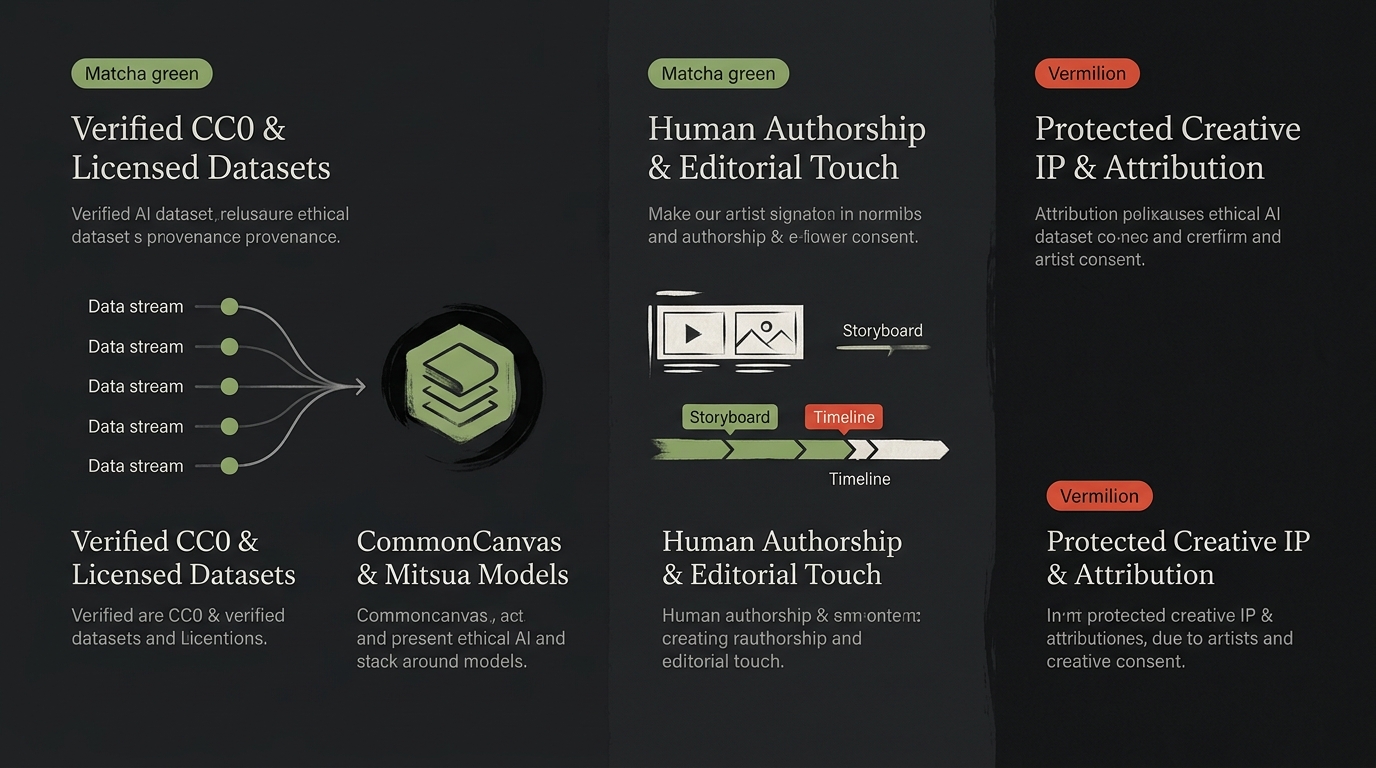
You should get to choose the tools your work is made with, including on this question, so we put the provenance right on the label. The model picker shows what each checkpoint was trained on before you commit to it.
Two of the models we ship are here specifically because their training data is clean:
- Mitsua One was trained from scratch on roughly 11 million public domain and CC0 images, plus images used with explicit permission. No copyrighted work without consent, and no AI-generated images in the set. It trades some polish for the strongest rights claim we can offer, and that trade is yours to make.
- CommonCanvas XL is an SDXL model trained on about 22 million Creative Commons images. It looks materially better and still stands entirely on openly licensed data.
An artist who never opted in was never in either dataset, which is the honest version of respecting consent. General anime checkpoints stay available too, but we mark those “provenance unverified” instead of dressing them up as something we cannot prove, and a deployment can be locked to the rights-cleared models only.
You’ll also be able to make the model your own. You’ll be able to fine-tune on your own drawings on top of CommonCanvas, our fairly trained base, so you’ll get a personal style built entirely from work you made and already own. Your source files stay yours, so you can retrain from them later. No scraping, no borrowed labor, and provenance that points straight back to you.
Every generation records the model, its license, and its training data alongside the result, so credit and disclosure stay possible long after the fact. Because you also do real editing here, storyboarding, grading, and recutting, the work you finish carries the human authorship that earns copyright, rather than the bare prompt output the law leaves unprotected.
Why we bother
This runs back to the reason we started the company. Respect for the people upstream and quality in the thing you ship come from the same instinct, aimed in two directions. We would rather build for creators who care about both, and give everyone else enough information to start caring if they want to.
Bring the vision. We’ll bring tools you can feel good about using. Come make it with us.